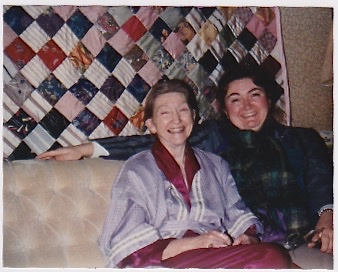
(That’s my mom on the left, a survivor of The Ferne Gene!)
Stuck like some thorn in my brain, I’ve simply gotta get this thing out! For the record, but mostly for just my own sake, released. Over the course of my life more than one sociopathic person has touched, and let ‘s just be honest, tormented me personally. But for reasons that I shall not elaborate on, I won’t presently delve into the most threatening among them. However, focusing on my maternal grandmother will do rather nicely as a transference of sorts.
Born Fern Lucetta Howard in ______, we knew her as MiMi. First uttered by my oldest brother David, he allegedly called her MiMi when he had few words in his vocabulary. Perhaps he really was trying to tell her, “Listen to Me, please Grandma! Me!” But, oh well, we wrote it MiMi. She died in ______. Yup, that woman was nearly 103 years old when she left to be with her “Sweet Jesus”. While Fern was pretty harmless in her latter years, in my heart I mused that deep down she was too mean to die.
When Fern was in her nineties my fascination with sociopathic and/or narcissistic personalities led me to surmise that her persona deserved placement underneath that broad umbrella. I flaunt no academic credentials to validate my diagnostic tone regarding my grandmother. I only claim her deficiencies in what I call the three big C’s: compassion, culpability and conscience. In all of these attributes, she was lacking.
Conversations on the topic were welcomed by my mother, a primary victim of Fern’s wicked abuse, both physical and mental. But my bold accusations were not received well by the few other family members on whom I tested the theory. In particular, I recall breaching the subject at breakfast with David, as well as my second-oldest brother Dan, on the day following a reunion event in Salinas, California. Their balking laughter informed me that our grandmother had entered into what I refer to as the “deified zone of life”. Too old and honored (e.g., at a family reunion) to label in such a way. How dare I even think such a thing?!
Yet in years prior, I recall it was David who coined the phrase “The Fern Gene”.
Insert Fern Gene section…
Researching and writing about my dysfunctional family roots, specifically regarding Fern, has by no means been an orderly endeavor. In fact, perhaps in large part due to recovery issues related to alcohol and other drugs, The Fern Gene project has spent years at a time on a shelf in my mind. This has been by no means a conscious choice. Besides mothering, employment and life in general, I’m gifted with too many creative ideas, which in turn is a curse to my time management.
Speaking of creativity, Fern hand wrote a book (titled Say It With Music) in five 3-ring binder volumes, four of which I am in possession of. To date I am not sure if Volume #1 was destroyed or lost or is still in the possession of some other extended family member. If the latter, I certainly hope an intervention occurs before it gets folded into an estate sale, where it could end up like a puzzle piece that nobody (but me) is looking for.
About this book, which she worked on from 1948 to 1983 (yes, 35 years!), it is an odd thing, little understood (even perhaps quietly mocked) by family members who’ve known of it’s existence. Truth is, it’s very unique, a full-fledged original. The various fictional stories throughout incorporate hundreds of song titles into their text, each underlined; but only the titles, and generally not any lyrics from the actual songs. Yes, I said “it is an odd thing”. But there’s more!
Consider that she was not schooled in music, only claimed expertise in whistling splendidly (as indicated in her pros when comparing herself to her favorite musician); and I have no clue how she amassed all the titles which spanned a wide spectrum of music, or for that matter how she stored them for retrieval, as needed. Did she keep lists, or were they all in her brain? Regardless, the song titles were inserted into sentences strictly because they provided suitable phrases or words to complete sentences. I wonder what inspired her to execute such a method.
Then there are the pictures, mostly taken from magazines, that she carefully cut and meticulously glued throughout. While working on The Fern Gene I’ve pondered my own affinity for collage art, and wondered if I witnessed her working on Say It With Music when I was a small child. Without conscious awareness, perhaps she influenced me?
She insisted in writing (to me in a letter, long before I came to possess it) that Say It With Music was not a “manuscript”; and indeed it does not have the look of one. But over time and several re-readings, and by factoring in clues found elsewhere, I’ve come to realize that it is a rich glimpse into her psyche.
The two main characters are pre-adolescent children, Kathleen and Harry, a pair who wander away the daylight hours (apparently not on school days) across a countryside rich with natural beauty and cute little animals that do them no harm. A Mother Nature seemingly short on bugs and mud, perhaps the set for my grandmother’s version of a Shirley Temple movie.
The brooks glisten and babble, while the two kids chatter about people they know, community controversies, even (and perhaps especially) the differences between how their respective families worship. Along their wandering way they happen upon local adult characters they either know or know of. On occasion they converse with total strangers. Yes, I know it is a fantasy. But the degree to which these two are unsupervised rings quite curious, given the true characters I discovered in and between the lines.
Harry Deeran, born into wealth and privilege, is age 7 at least in volume 2. He’s an accomplished musician who plays the organ in concerts frequently, studies Chopin, in fact dreams of “playing on a big organ someday”. Out on the trail with Kathleen he plays the mouth organ, or an “expensive harmonica” as she calls it, and she will sometimes dance to his music on a tree stump. I am not sure if Kathleen wore tap shoes in the forest. But before ever learning of the book, I knew how much my granny adored Shirley Temple; so, anything ‘s possible!
Kathleen Shanahan’s family seems the direct opposite of Harry’s in multiple ways. Not well to do, less educated. And their church upbringing differs greatly. Harry refers to one church in particular as “the best church for all you country folks” , and that “we Deerans just wouldn’t fit in there. We go to the E-Piscopal Church.” (Yeah, that’s how she wrote it.) Elsewhere in the writing Kathleen, presumably a bit younger than Harry, questions how he says his prayers, talks about seeing God in her heart, and implies that his faith is not solidly bible-based. But still Harry is her trusted protector, the boy who convinces Mrs. Shanahan “that he will keep Kathleen safe”. And so their expeditions continue.
However, back in the real world, likely for some years that overlap with her writing, there was a real Harry in Fern’s life. No, he was not hers to have and wander with. But I have no doubt she wanted him, at least visualized wanting him. And she was a presence in his life, though not necessarily a welcome one.
Harold Leighton Reed was in fact the hired professional organist for the Rhodes Department Store in downtown Seattle from 1933 to 1966. Yes, he played “the big organ”. And yes, my granny shopped, or at least lingered, at Rhodes. In fact, by current standards, she exhibited a sort of stalking behavior. At minimum she was an annoying presence, especially to the wife of Harry Reed. How Mrs. Reed came to know of Fern’s antics, I am not sure. She may have discovered it directly, or heard of it from her husband, or perhaps from a friend. I’ll likely never know. But, according to my mom, Mrs. Reed asked store management to do something about that woman swooning over her husband. And other (of my) family members were privy to her obsession. A cousin of mine, at about the age of five, was taken by Fern to the department store. Decades later at a family reunion that cousin described our grandmother sliding across the marble floor to the organist’s music, then dining on crab louie salad in the nearby store restaurant, so as to continue listening to Harry Reed play.
Well over twenty years following the crab louie tale, in fact about six months ago, that cousin’s daughter (my second cousin) divulged to me an added variable via a private Facebook messenger chat. In conversation with her own grandmother (my mother’s sister), she too was made aware of Fern’s obsession with an organist. Plus, she heard that Fern had made some sort of a threat on Harry Reed, that she’d throw acid on his face, and his wife found out.
Needless to say, this nugget of Fern lore sent my mind wildly wandering. No acid ever got tossed. Otherwise, I’d know that for sure! But, if rebuked (or simply just told to go away) by the adored Harry Reed, I actually can visualize Fern being angry enough to make such a threat. This makes a formal complaint by Harry’s wife sound even more plausible.
I also suspect that it was no accident that the book Harry had the surname Deeran. Reverse the first four letters, and you have Reed.
As for the husband in Fern’s real world, Everett Amos Hawkins (aka Pop to us grandkids), where in the hell was he when Fern was behaving like an unhinged organist groupie? Based on the estimated age of my cousin when she witnessed Fern’s insipid swooning, I surmise that at least some of it was going on in the fifties. Once I figure out when Pop was working in Adak, Alaska, some timeline clarity should start to appear. Then too he and Fern were eventually divorced, sometime in the sixties. And I never had a clear understanding of how that all came to be. But I sense I’m getting closer to a possible understanding.
 EklektikosByStar
You must be logged in to post a comment.